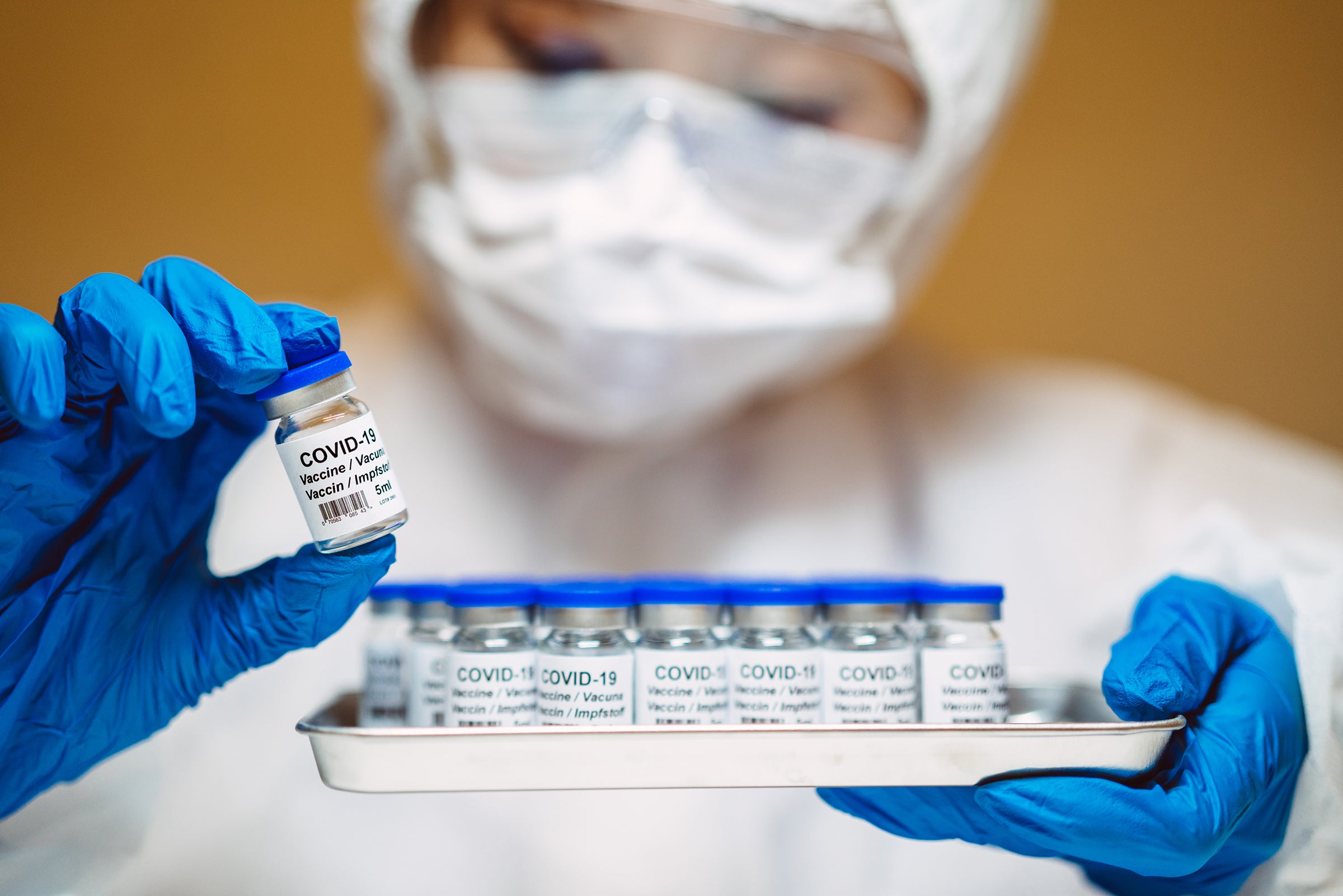
Both Pfizer and Moderna use the same genetically crafted vaccine technique, which includes messenger RNA molecules. Presuming the U.S. Food and Drug Administration authorizes the vaccines for” emergency situation usage,” each company will need to increase production and distribution significantly. Pfizer anticipates to produce as much as50 million doses worldwide in2020 and as much as 1.3 billion in2021 Moderna intends to manufacture approximately20 million doses in2020 and500 million to one billion in 2021. An individual getting either vaccine will require two dosages, administered 3 or four weeks apart.
Numerous actions are needed to provide a lot of little glass vials of vaccine to local medical facilities and pharmacies, where the medication can be injected into a person’s arm. Moderna’s vaccine has to be shipped at–20 degrees Celsius(– 4 degrees Fahrenheit), and it can then be stored at that temperature level for 6 months. Once defrosted and kept in a fridge in between two and 8 degrees C (36 to46 degrees F) it benefits up to30 days. Pfizer’s vaccine should be kept at–70 degrees C(– 94degrees F)– a much higher difficulty. As soon as moved to a fridge, it needs to be administered within five days.
.
In the U.S., Moderna will manufacture its vaccine in New Hampshire, Pennsylvania and Indiana. It will deliver vials to McKesson Corporation’s distribution center in Irving, Tex., the center of the federal government’s Operation Warp Speed vaccination initiative. Moderna also plans to produce the intervention in Switzerland and Spain. Pfizer will make its U.S. vaccine in Kalamazoo, Mich. It is not dispersing through Operation Warp Speed, so it will deliver big thermal boxes of filled vials, jammed with solidified carbon dioxide, via business such as UPS and FedEx to areas around the country. Pfizer likewise has a production site in BelgiumOn November 16 the business released a pilot program to check its delivery strategy to four states: Rhode Island, Tennessee, Texas and New Mexico.
What will it take for this network to effectively distribute enormous numbers of vials? How is vaccine securely protected?
[An edited transcript of the interview follows.]
Moderna’s shipping temperature will be–20 degrees C. Is that typical for frozen products? And is Pfizer’s temperature of–70 degrees C extreme?
There are different cold chains. The ultralow chain, the deep freeze, is the one at–70 degrees C. There’s the “frozen” chain, at–20 degrees C, which is more like a regular freezer. And after that [there is] the refrigerated chain: Numerous vaccines, like flu vaccines, are refrigerated in between two and eight degrees C. Just a couple need to be frozen to–20 C, such as [those for] varicella and zoster. The Ebola vaccine did have an ultracold supply chain. Some animal vaccines, like vaccines for chickens, are kept ultracold, too.
What kind of facilities can manage–70 degrees C?
Not that many. They might perhaps send vaccines from there to their retail stores, all of which will have preplanned who is going to get vaccinated.
The vaccines do not have to stay frozen right approximately the time of shot.
The CDC has a playbook for states, publicly available, that lays out what you can do with vaccine type A or vaccine type B. It states when a center gets a thermal carrier [such as that from Pfizer], it has to replace the dry ice within 24 hours and again every 5 days. And you can just open package one or two times a day. After day 15 from when the vials were produced, they need to be transferred to refrigerated temperatures and used within five days. There is some time to vaccinate people.
Pfizer’s thermal shipper holds 975 vials.
I don’t see that as an obstacle in the U.S. Freight business require to make money right now, so they’ll run additional flights if they require to get the 50 million dosages to the locations. You can imagine a hub-and-spoke system shipping direct to centers around the nation. They wish to cut the extra 2 days off the preparation: Moderna vaccine first goes to the McKesson distribution center and, from there, goes to the service providers– that most likely includes a number of days. Worldwide, however, the challenge of a Pfizer vaccine is quite substantial. One study approximated there are just 25 or 30 countries that have the ultracold facilities.
Each Pfizer vial really provides five dosages. How is that handled?
The location doing immunization adds a dilutant, developing 5 doses.
It seems like places require to line up a lot of recipients so vaccine is not squandered.
What I’ve seen is that each Pfizer tray has 195 vials, each with 5 dosages, so that has to do with 1,000 dosages. And a box can hold up to 5 trays. If, in the start, you are focusing on by immunizing just frontline employees who are dealing with COVID-19 clients, you ‘d want to line up sufficient people at one area to utilize a tray of vaccines within five days, or have individuals from the area concerned you. States might likewise acquire sub-80 freezers. The New York State plan states it will establish several regional distribution centers. If they do that, then they will probably have sub-80 freezers at each area. I do not understand if their plan will change now that Moderna has come out with more info.
I believe most states will not have the resources to set up local distribution centers. What I would do if I were them is search for big medical facilities that do have the freezers and use those as the points of circulation. I would certainly partner with the local pharmacies. And I would look at designs where you drive a few of it around: deliver it to one location, then drive a regional van around with refrigeration that can store vials for five days. And you can ask people to drive to locations to get vaccinated. I think all of these [steps] will occur. Obviously, there will be questions of equity, a minimum of in the beginning, when vaccination is dependent on simply the Pfizer vaccine.
What about putridity? Pharmaceutical companies report that from 5 to 20 percent of other vaccines ruin throughout distribution.
That will have be factored in. There is a method to keep track of the thermal shipper with a temperature probe. In the perfect world, the monitoring would decrease to the private vial, however I don’t understand if current innovation will enable that. We might take a look at how Ebola vaccine has been distributed around Africa; it is a customized cold chain.
What about production quality control?
In typical vaccine production and shipping, potency and stability are examined. Certainly, Pfizer and Moderna are doing that.
All of this is complicated by the truth that each person needs to get two injections, 3 or 4 weeks apart. Immediately, the number of people who could be immunized is cut in half.
And for each person, your 2nd dose has to be the exact same as your very first dose, either Pfizer or Moderna.
We’ll all require accurate records.
There are a lot of challenges with the details side of the supply chain. The business are sending out item to distributors, however they are not responsible for who gets vaccinated.
That’s mainly how public health works. There’s one system for purchasing and shipping vaccines, but it doesn’t tell you anything after a vaccine has arrived at an area. Typically, each state utilizes its own system for registering who gets vaccine– that’s called the immunization registry.
There are systems that can do this– like those that collaborate diagnostic testing. They will have to be rolled out. They supply 2 genuine benefits: One is that you can tell customers where they can go to get [a] vaccine– not where it’s been delivered but if there’s any left. And if business understand where the stock is, they can make much better decisions about where to send the next batch. Or areas can increase public messaging to raise demand for a vaccine, due to the fact that we understand there will be issues with individuals being hesitant to get it.
I imagine the vaccination prioritization schedules that we’re simply finding out about might make details tracking even harder– you understand, frontline employees ought to get the vaccines first, then instructors, and so on.
The National Academy of Medicine advises phases: first high-risk workers in health care centers plus very first responders, then individuals with hidden conditions that put them at high danger, then, later, teachers, then young people, then the rest of us. There is also speak about sending out the early vaccines to locations of high occurrence of disease. All of that makes complex the details side of the vaccination challenge.
Due to the fact that it’s most likely that just big institutions might offer ultracold storage, it has actually been recommended that Pfizer’s vaccine might end up going to cities and Moderna’s vaccine could end up going to less largely populated areas.
When we have sufficient supply of any vaccine you want, then the market will choose Moderna over Pfizer– as long as the safety and effectiveness are high enough– because of the refrigeration distinction. In the early phases, with so numerous individuals everywhere requiring vaccine, I think a lot of choices will be made based on what is finest for the system.
Read more about the coronavirus outbreak from Scientific American here And read coverage from our worldwide network of magazines here

Comments
Post a Comment